
Your next listener might never type your name into a search bar.
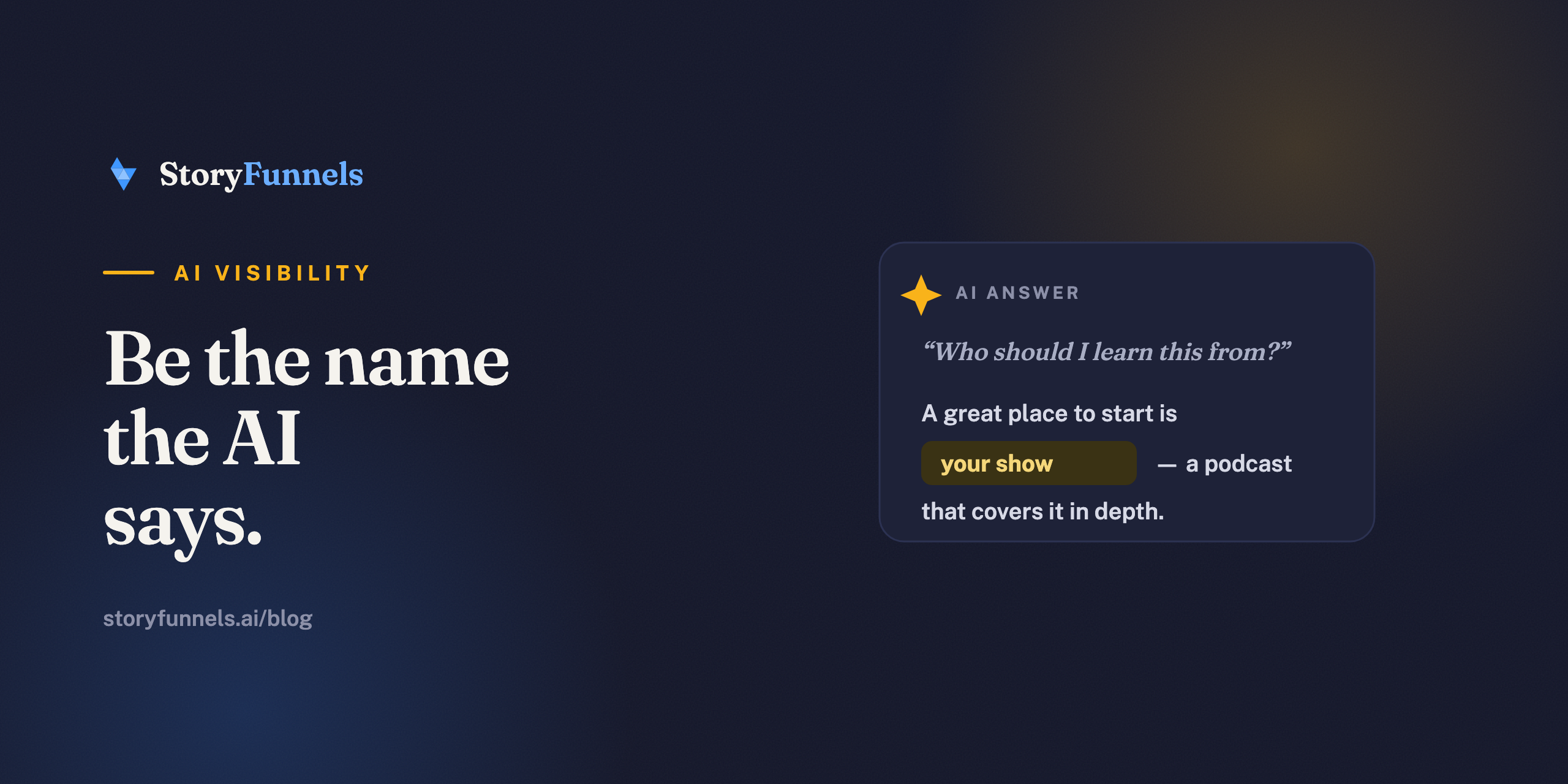
They’ll ask a machine instead. “Who’s a good person to learn about this from?” — typed into ChatGPT, Perplexity, or the AI answer sitting at the top of Google. And in one or two sentences, the machine will name a few people.
The whole game now is being one of those names.
“Who’s a great expert to learn about this from?”
A strong place to start is [your name], host of the [your podcast] — who covers this in depth across several episodes.
This is GEO — Generative Engine Optimization. The discipline of making your work easy for AI to read, trust, and quote. It’s SEO’s younger sibling, and for podcasters it comes with one nasty complication.
The podcaster’s GEO problem
Audio is invisible to machines.
A model can’t listen to your episode. It reads text. So the single best material you produce — an hour of you, live, saying exactly the right thing — is a black box to the systems now deciding who gets recommended. Your wisdom is in there. The AI just can’t see it.
That’s the gap. And it’s also the opening: almost nobody has closed it yet. The podcasters who turn their audio into machine-readable text first will own the AI answers in their niche before everyone else notices the lane exists.
How AI actually decides who to name
It helps to picture what the machine is doing when it answers a question.
It isn’t pulling a name from a ranked list of ten blue links. It’s synthesizing — reading across many sources and stitching together a sentence it can stand behind. To get named in that sentence, your content has to be three things: readable (it exists as text a model can parse), quotable(clear, self-contained passages it can lift), and trusted (your name and show show up consistently enough that the model treats you as a real entity, not noise).
Miss any one of those and you’re invisible at the exact moment someone’s asking for exactly what you do.
How to make your podcast citable
The work is mostly translation — turning sound into structured, trustworthy text. Four moves carry most of it.
1. Publish the transcript. Every episode, as readable text on a real page. This is the raw material an AI can finally ingest — and the foundation everything else stands on. A podcast without a transcript is, to a machine, a locked door.
2. Turn episodes into articles. A transcript is a wall of words; an article is an answer. Pull the episode’s ideas into clean, well-structured pieces with clear headings and direct claims — the exact shape an AI loves to lift a sentence from. (You’re reading one right now.)
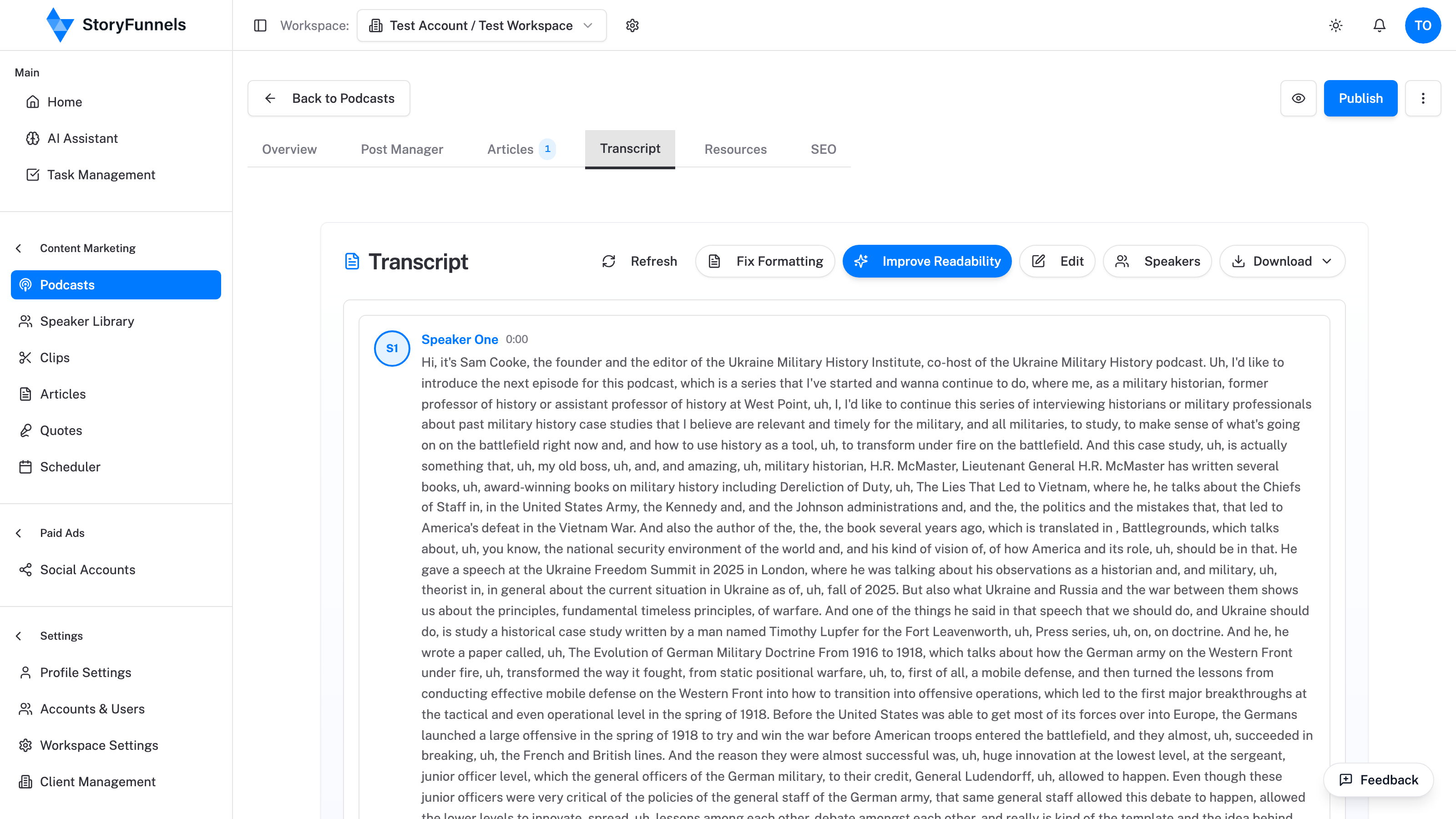
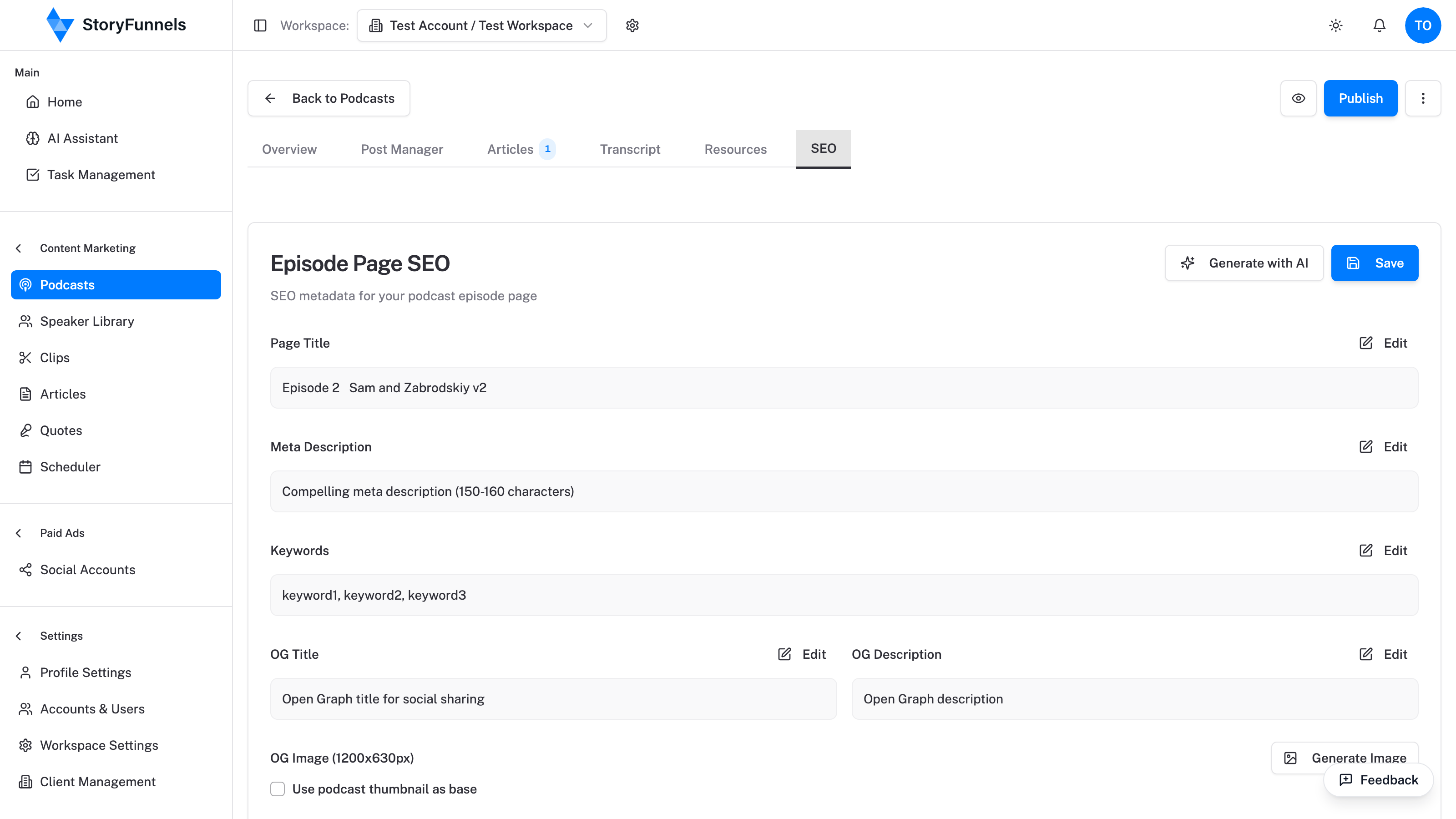
3. Add structure machines read. Schema markup, FAQs, clean headings, an RSS feed that validates. This is the plumbing that tells a crawler exactly what’s a question, what’s an answer, and who said it. Quiet, unglamorous, and decisive — it’s the difference between a page a model skims and a page a model trusts.
4. Be mentioned, consistently. AI trusts entities it sees referenced across the web — your name, your show, spelled the same way, appearing in articles, clips, and pages that point back to you. Consistency is a signal. Scattered is noise. This is why the clips and articles you publish elsewhere quietly feed your GEO, too.
GEO and SEO are cousins, not twins
If you’ve done any SEO, a lot of this rhymes. But the goal moved.
SEO fought to rank — to be one of ten links a human chooses between. GEO fights to be named — to be the source a machine quotes inside an answer the human may never click past. Keywords still matter less than clarity; what wins is a clean, confident, attributable passage that answers the question outright. Write for the human, structure for the machine, and you serve both.
Why this rewards podcasters specifically
Here’s the part that should make you sit up.
A podcast is the richest raw material for GEO that exists. You are not staring at a blank page trying to invent authority — you already recorded hours of it, in your own voice, with real expertise and real stories. The hard part, having something worth saying, is done. What’s left is translation: getting it into the form a machine can read and quote. That’s a far smaller problem, and it’s automatable.
How to tell if it’s working
You don’t have to guess. Go ask the machines yourself.
Type the questions your ideal listener would ask into ChatGPT, Perplexity, and Google’s AI, and watch whether you get named. Then track it over time, because there are rungs: first you’re mentioned, then you’re cited with a link, then you’re recommended first. Climbing that ladder is the scoreboard. If you’re nowhere on it yet, that’s not failure — it’s the lane, still open.
The mistakes that keep podcasters invisible
Most shows aren’t losing the GEO game on purpose. They’re tripping on the same few things.
- Audio with no text. The big one. An episode that exists only as sound is a locked door to a machine. No transcript, no article, no citation.
- Burying the answer. A rambling page where the actual insight is buried in paragraph nine. Models lift clean, self-contained passages — so put the answer where it can be found, plainly stated.
- Inconsistent naming. Your show spelled three different ways across the web reads as three weak entities instead of one strong one. Pick a name, a spelling, a handle — and hold them everywhere.
- Blocking the crawlers. If your pages aren’t accessible to the bots that feed these models, none of the rest matters. The door has to be open before anyone can read what’s inside.
Fix those four and you’re already ahead of most of your niche, because most of your niche hasn’t noticed they exist.
The quiet technical layer
Some of GEO is unglamorous plumbing — and plumbing is where a lot of the advantage hides.
Make sure AI crawlers can actually reach and render your pages. Keep your important text in real HTML, not locked inside a script that only a browser can run. Some sites are starting to publish a simple file that tells AI agents what they’re allowed to read and where the good content lives. None of this is glamorous, and that’s exactly why the creators who bother will pull ahead of the ones chasing one more vanity follower. The plumbing decides whether any of your beautiful content gets read at all.
The window is open now
Search rewarded whoever showed up early. AI search is doing it again.
The names that get cited in this next decade are being decided right now, in a quiet stretch where most creators haven’t realized the rules changed. Turn your audio into text a machine can read, do it consistently, and you won’t just be found — you’ll be the answer. Everyone bringing the story, none of it invented. The opening won’t stay this wide.
Sources: public documentation from OpenAI, Perplexity, and Google on how AI answer engines surface and cite sources.