You could record a podcast this afternoon. On your phone. Live on Spotify by tomorrow.
Which is exactly the problem. So could three million other people. The barrier to making a podcast fell through the floor years ago — and the barrier to being heard climbed higher than it has ever been.
Most “how to start a podcast” guides stop at the microphone. They hand you gear lists and hosting tips, wish you luck, and leave you staring at a download count frozen at 14 — twelve of which are you, refreshing to check it worked.
This is the other guide. The one about the part that actually decides whether your show lives.
Start with the story, not the gear
The biggest mistake new podcasters make has nothing to do with equipment.
They treat the podcast as a format instead of a story. Pick a name, buy a mic, sit down — and then say something a listener could get from ten other shows. Gear is a rounding error. What people subscribe to is a point of view.
So before you record a word, answer three questions in one sentence each:
- Who is this for?
- What change do you want to create in them?
- And why are you the person to say it?
If you can’t answer the third one, you don’t have a podcast. You have a hobby with a microphone. That’s fine — just be honest about which one you’re building, because the honest answer changes everything that comes next.
“Stop competing on price. If you want to set yourself apart from your competition, tell better stories.”
That isn’t a slogan. It’s the whole strategy. The shows that break through don’t have the best microphones or the slickest edits — they have a clear, true story and the stubbornness to keep telling it.
The setup, in plain English
Here’s the entire technical checklist, with the gatekeeping stripped out:
- A microphone. A USB mic in a quiet room beats a $2,000 setup in a noisy one. Don’t overthink it.
- A format. Solo, interview, or co-host. Pick the one you can sustain — not the one that sounds impressive.
- A recording tool. Anything that captures clean audio. Record remote guests on separate tracks so you can fix problems later.
- A host. Where your audio lives, and where your RSS feed comes from. More on that in a second.
That’s genuinely it. You can be live within a day.
The hard part isn’t on this list. It’s everything that happens after you hit publish.
How your show actually reaches Spotify and Apple
Nobody explains this part cleanly, so here it is: you don’t upload your episodes to Spotify and Apple one by one. You publish them to a host, which spins up an RSS feed — a single web address that lists your episodes. You hand that one feed to each platform once (here’s the exact process for getting on Spotify). After that, every new episode fans out on its own — Spotify, Apple Podcasts, Amazon Music, YouTube Music, all of it.
RSS is the quiet plumbing under the entire podcast world. It’s why podcasting stays open when most modern media doesn’t: no single company owns it. It also means your real home base is your host and your feed — not any one app. Pick a host that handles this for you, and you’ll never copy-paste an episode into six dashboards again.
The wall everyone hits: discovery
So you’re published everywhere. Congratulations. Now meet the wall.
Being available on Spotify is not the same as being found on Spotify. Podcast apps aren’t search engines — they’re jukeboxes for shows people already know. Discovery doesn’t happen inside the app. It happens everywhere else: in a clip a friend forwards, in an article that ranks, in a quote that gets screenshotted at 1 a.m.
And lately, somewhere brand new.
Inside AI answers. Your audience has started asking ChatGPT, Perplexity, and Google’s AI “who’s a good person to learn this from?” The shows that get named in those answers win the next decade — and a podcast is the richest possible raw material for it, if it’s structured so a machine can read it. Most aren’t. That’s an open lane, and it won’t stay open.
The consistency trap (where most shows die)
Podcasts don’t fail at episode 1. They fail around episode 7.
The recording is the fun part. What kills shows is the grind bolted around it — cutting clips, writing captions, posting to six platforms, drafting show notes — after every single episode, forever. A part-time job stapled to a creative one. It’s why the internet is a graveyard of shows that stopped, mid-sentence, at “Episode 6.”
If you take one thing from this article, take this:
Plan the promotion before you plan the content. A show you can sustain every other week beats a weekly show you quit. And whatever you can lift off your own plate — automate it, delegate it, systematize it — is the difference between a podcast and a former podcast.
Where a tool earns its place
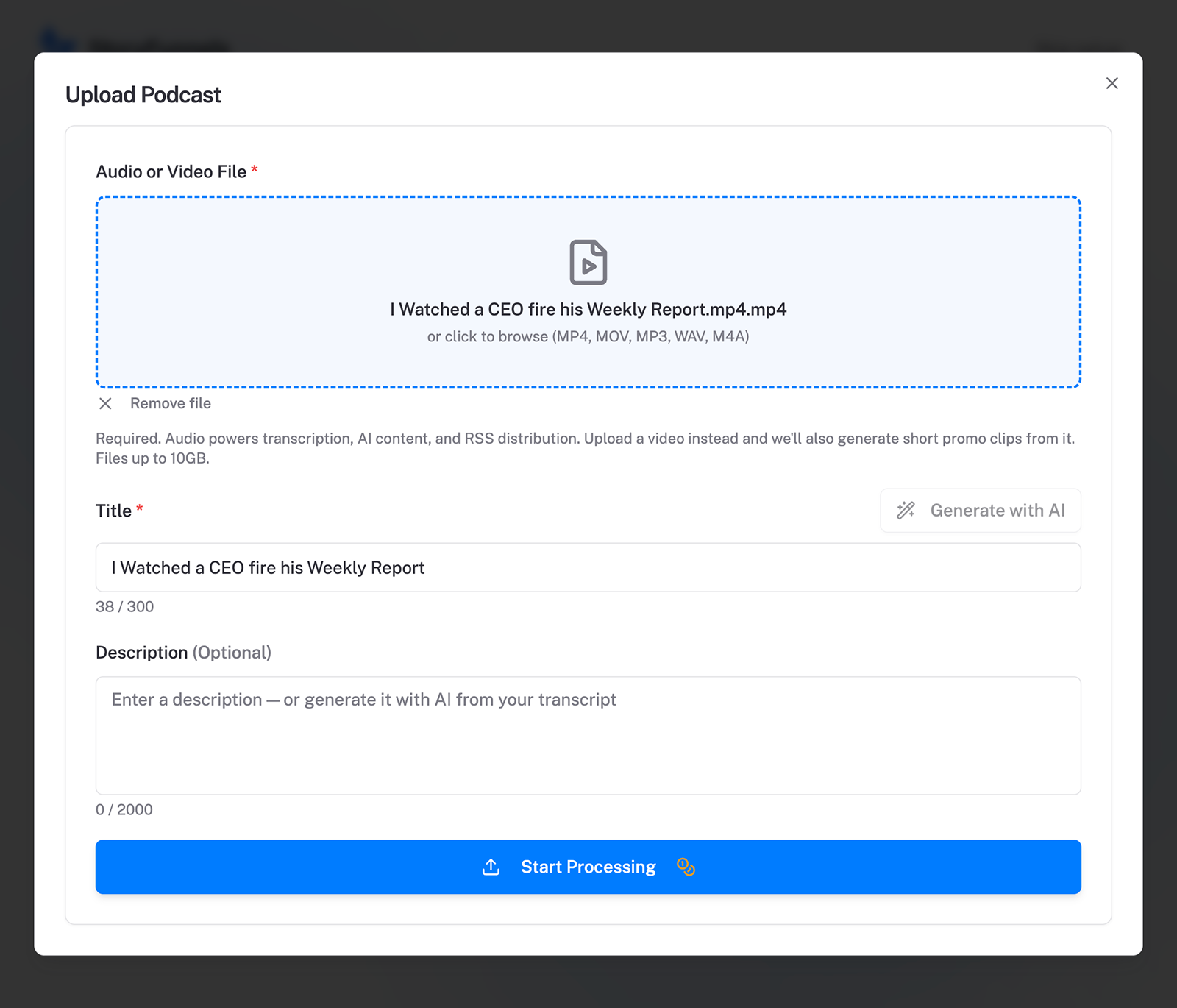
This is the part begging to be systematized — and the exact part StoryFunnels was built to take. The principle is simple: do the work once, then let it travel. One recorded episode already holds a month of content; the labor is only in extracting it. So that’s what gets automated — the clips, the quote cards, the article, the show notes, the scheduling, and the structured, machine-readable pages that make you findable by both Google and the AI answer engines.
Do the work once. One episode becomes a month of content — in your own words, never invented.
And none of it is invented. Every clip and quote comes from your episode, in your own words — so the story stays true, never hallucinated. The machine does the labor. You keep the soul. That’s the whole bet: bring the story, and let distribution stop being the thing that makes you quit.
Your story deserves to be found
Starting a podcast is easy. Building one people can actually find is a discipline.
And it comes down to three things, in this order: story, consistency, distribution. Get those right and the gear truly stops mattering. Get them wrong and the best microphone in the world records, beautifully, into the void.
Record once. Make it travel. Start free and turn your next episode into a month of content that actually gets found.