
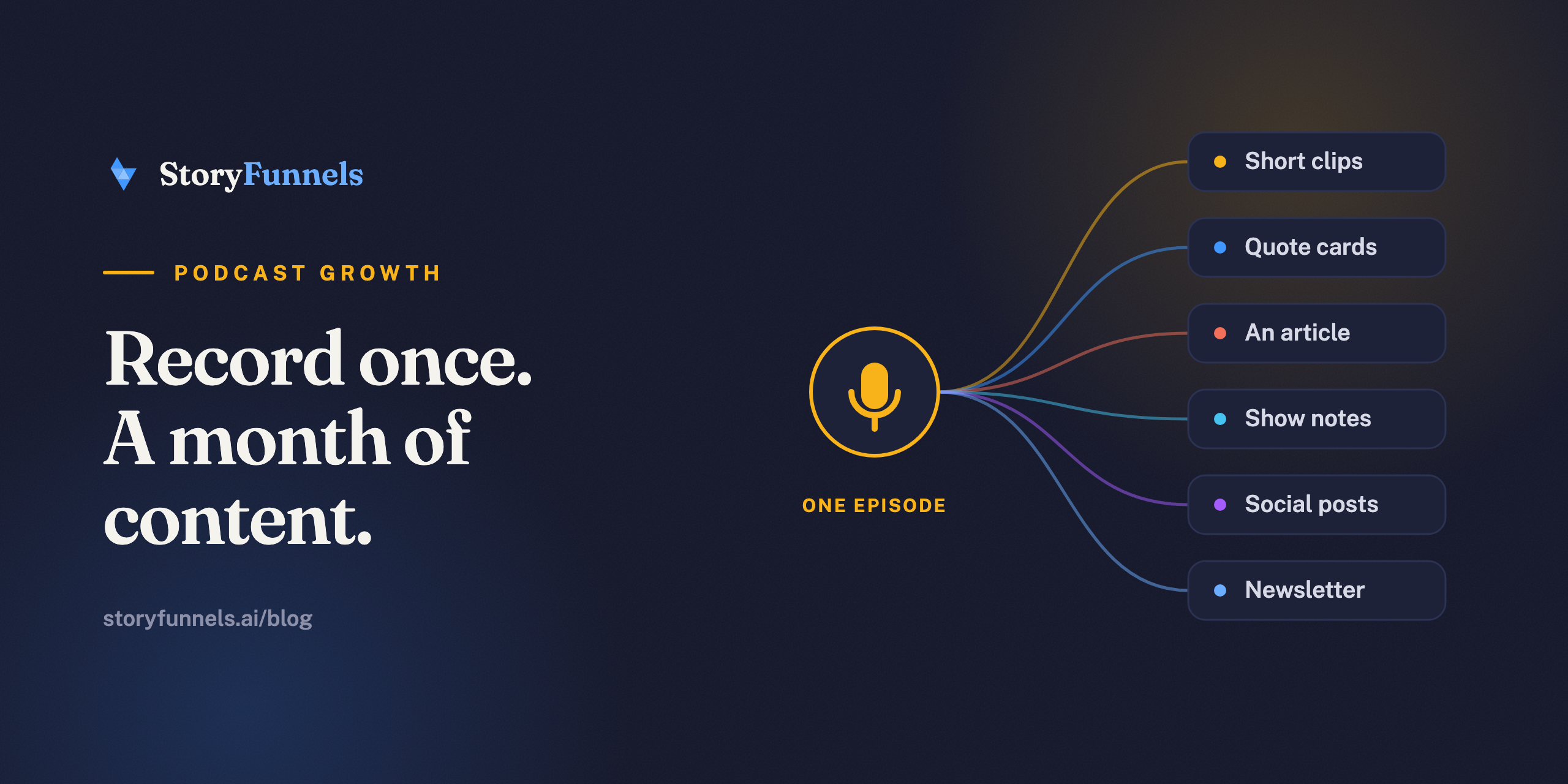
You already made a month of content. You just called it “one episode.”
Buried in that single recording is a week of clips, an article, a fistful of quote cards, show notes, a newsletter, and a dozen social posts. The work is done. It’s sitting in the file. The only thing standing between you and a full content calendar is extraction.
That’s the whole idea. Do the work once. Then let it travel.
“Recording podcasts … these kinds of things are permissionless. You don’t need anyone’s permission to do them.”
Naval’s point is about leverage, and a recording is the purest kind a creator gets: make it once, reproduce it forever, at zero marginal cost. The episode is the asset. Everything else is just the asset, reshaped for a different room.
One recording, many doors
Here’s what a single episode actually contains, before you write a new word.
Do the work once. One episode becomes a month of content — in your own words, never invented.
Each of these isn’t a copy — it’s a different door into the same idea. And that matters more than it sounds, because your audience isn’t standing in one place waiting.
The full inventory of one episode
Walk through what’s actually in there. It’s more than people expect.
- Short clips — the three to five sharpest moments, vertical and captioned, for Reels, TikTok, Shorts.
- Quote cards — one striking line each, set in type, for the feed and Stories.
- An article — the episode’s ideas restructured to get found by search and AI.
- Show notes — a scannable summary with timestamps and links, on the episode page.
- A newsletter — the same ideas, in your subscribers’ inboxes, where the warmest audience lives.
- A carousel — the big idea broken into swipeable beats.
- An audiogram — a waveform-over-art clip for the audio-only moments worth sharing.
Seven outputs. One recording. Not a single new idea required — only translation.
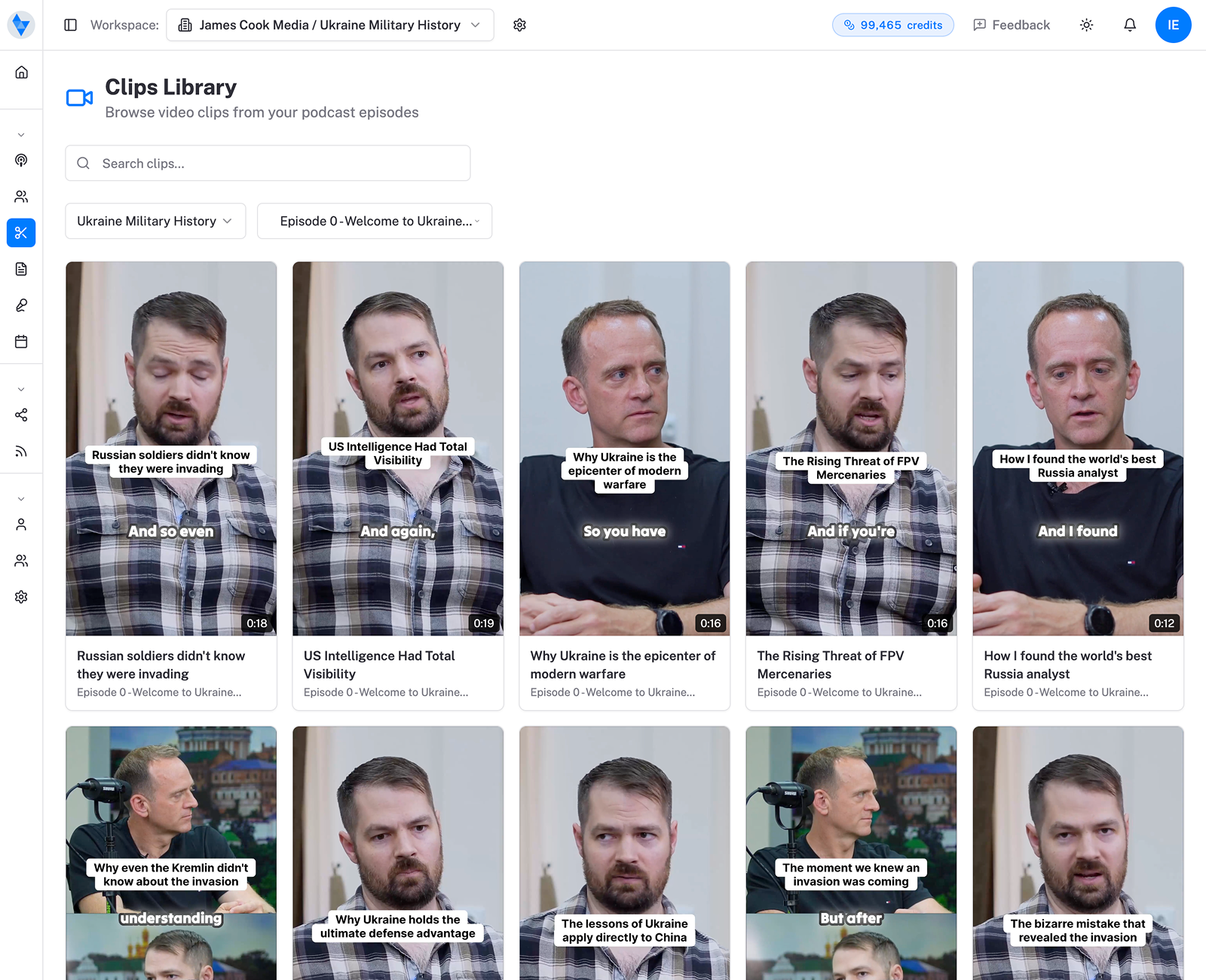
Why repurposing isn’t repetition
The fear is always the same: won’t people get sick of seeing the same thing?
They won’t — because they’re never in the same place when they see it. A clip catches someone mid-scroll. An article catches someone mid-search, weeks later, typing a question into Google. A quote card catches the skimmer who’d never press play. A newsletter catches the person who already loves you and wants more. Same truth, four completely different people, none of whom saw the other three.
Repetition is saying it twice to the same person. This is saying it once, in the rooms where each person actually lives.
The part that breaks people
So why doesn’t everyone do this? Because the extraction is a grind.
Scrubbing an hour of audio for the three best moments. Cutting and captioning each clip. Writing the article. Designing the quote cards. Drafting show notes. Then doing it again next week, and the week after, forever. It’s a second full-time job stapled to the creative one — and it’s precisely where most shows quietly stop around episode seven.
Which is the real argument for automating it. Not to do more. To make the thing you already do survivable.
A weekly system you can actually keep
The trick is to make repurposing a routine, not a heroic effort. One rhythm that works:
- Record once a week, same day, same setup. Protect that slot like a meeting with your most important client.
- Extract right after, while the episode’s fresh — clips first, then the article, then the cards.
- Schedule it out, dripping the assets across the next week or two instead of dumping them all at once.
- Then forget it and go record the next one.
The goal isn’t a frantic launch day. It’s a quiet machine that turns one hour of recording into two weeks of presence.
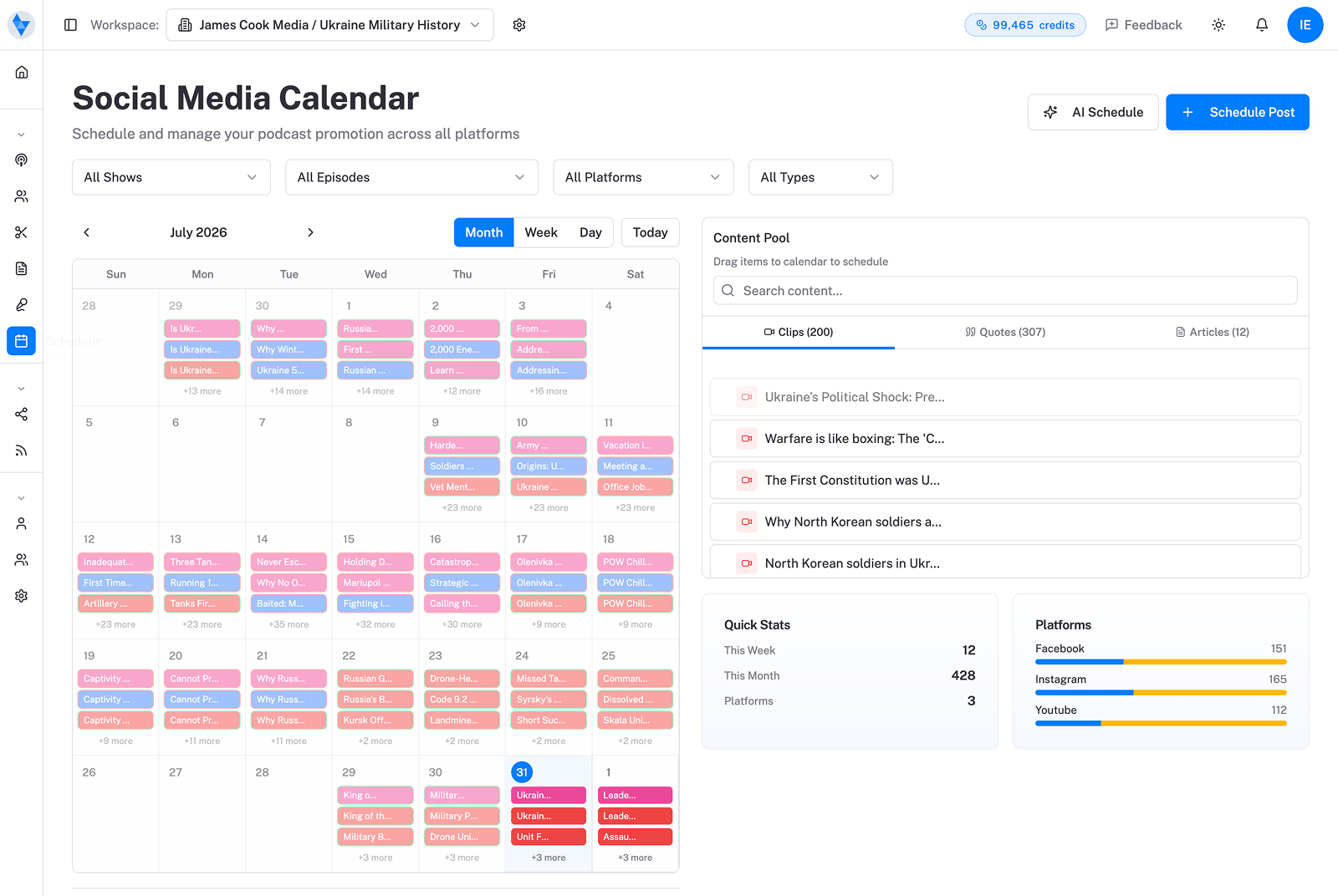
Where each piece goes to work
Repurposing only pays off if each asset lands where it belongs.
The clips go to Instagram and Facebook, where they catch strangers. The article gets you found by search and AI, where it works for months. The audio fans out to every platform through your feed, where your subscribers already are. One recording, working in a dozen places at once — and crucially, all of it in your own words, never invented.
The 80/20 of repurposing
If the full list feels like a lot, good news: it isn’t all worth the same.
Most of the discovery comes from a fraction of the assets. Clips do the heavy lifting — they’re what reaches strangers. The article is second, because it works for months and feeds both search and AI. Everything else — quote cards, carousels, the newsletter — is leverage on top, valuable but optional.
So if you only have the energy for two things this week, cut clips and write the article. Skip the rest without guilt. A sustainable two beats an ambitious seven you abandon by next month. The system only compounds if you actually keep doing it.
Batch, don’t dabble
The enemy of repurposing isn’t effort. It’s context-switching.
Cutting one clip, then writing one caption, then designing one card, then jumping back — that’s how an hour of work becomes a lost afternoon. Batch instead. Find all your clip moments in one pass. Write all the captions in another. Design the cards together. Your brain stays in one mode, and the same work takes a fraction of the time. Better still, batch across episodes: process two at once and the setup cost amortizes.
This is also exactly the kind of repetitive, rules-based labor that machines are now genuinely good at — which is the whole argument for handing it off.
Picture one good minute of an episode. That single moment becomes a vertical clip for Reels, a quote card for the feed, a line in your newsletter, the hook of the article, and a timestamp in your show notes — five assets, five different rooms, from sixty seconds you already recorded. Now multiply that by the three or four best minutes in every episode. The content was never the bottleneck. The extraction was.
What to cut, and what to never cut
One caution, because it’s where repurposing goes wrong.
Never let the volume dilute the voice. A clip ripped out of context that misrepresents what you said, a quote card with a line you didn’t really mean, an article that flattens a nuanced point into a hot take — that’s reach bought at the cost of trust, and it’s a bad trade. The rule that protects you is simple: every asset comes from what you actually said, in your own words. Pull from the episode, don’t invent around it. Reach is worthless if it misrepresents you to the very people you’re trying to win.
The math that makes it worth it
Forty-eight episodes a year feels like forty-eight pieces of content. It isn’t.
Run each one through the system and it’s closer to a thousand — clips, articles, cards, posts, all pointing back to the same body of work. That’s not hustle. That’s leverage: the same hour of recording, found by a hundred times more people. Bring the story. Let the machine carry it everywhere else.